

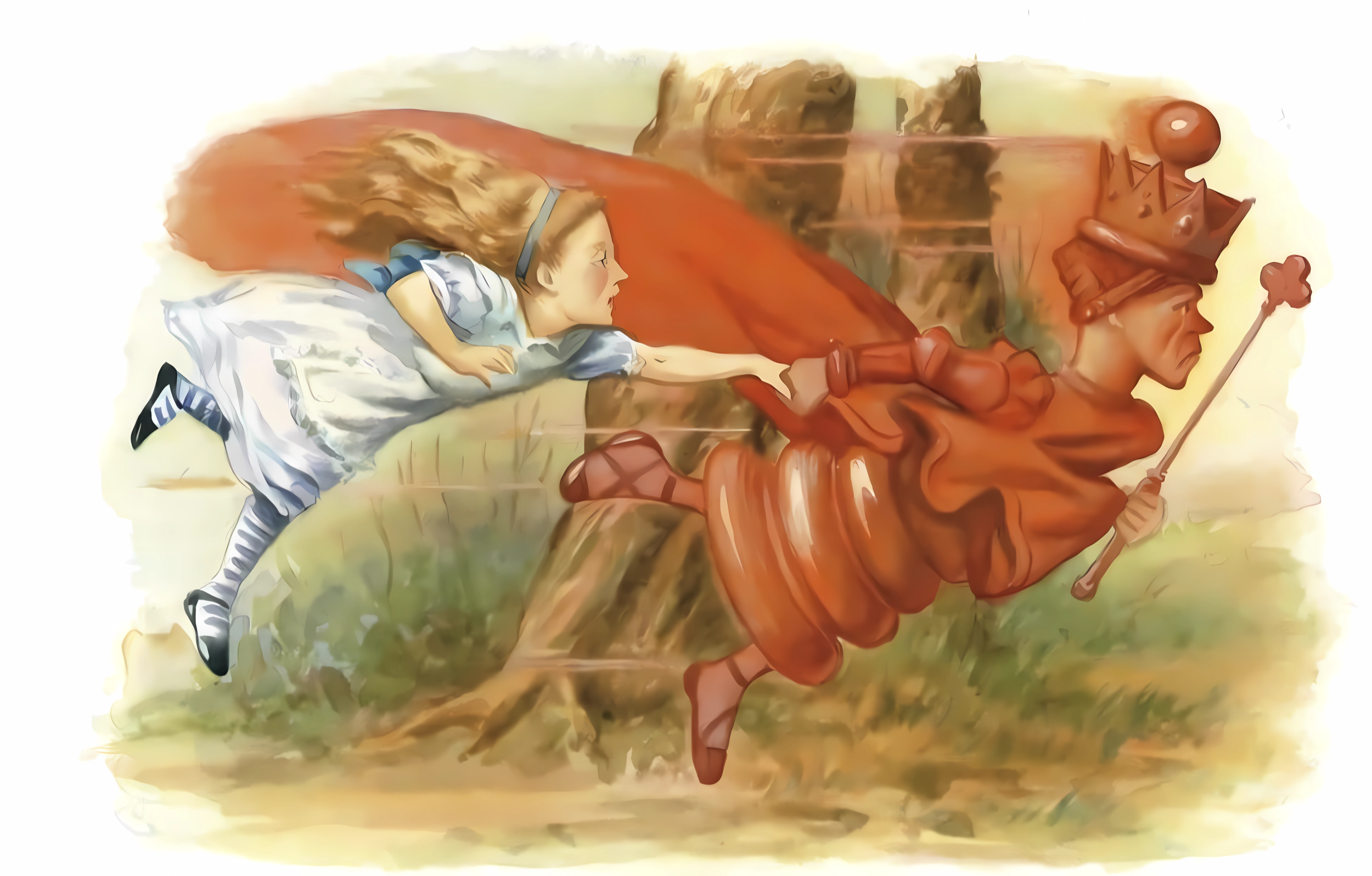
Those of you who know the Red Queen from ‘Alice in Wonderland’ might guess that a kiss from the lady is not necessarily a pleasant experience. The topic I would like to address is why constant change and reinvention are crucial for an organization’s survival. To make my point I would like to introduce you to a phenomenon in Nature – the Red Queen Effect.
Even though I do not necessarily believe in Evolutionary Theory (honestly – who wants to originate from a monkey?), I do find certain aspects of Evolutionary Theory interesting and strikingly similar to what happens in the marketplace.
According to Wikipedia the Red Queen Effect, is an evolutionary hypothesis which proposes that organisms must constantly adapt, evolve, and proliferate not merely to gain reproductive advantage, but also simply to survive while pitted against ever-evolving opposing organisms in an ever-changing environment. Does this ring a bell? Do you see any similarities to the challenges you encounter with your competitors within your business environment?
The original idea of the Red Queen Effect was given by Leigh Van Valen an American evolutionary biologist and professor at the University of Chicago. Van Valen showed that in many populations the probability of extinction remained constant over millions of years. The Red Queen’s Hypothesis captures the idea that there is a constant ‘arms race’ between co-evolving species.
What is an evolutionary ‘arms race?’ you might ask. Richard Dawkins an English evolutionary biologist answers this question as follows: “arms races in biology are about coevolution, particularly coevolution between enemies: between predator and prey, between parasite and host. Adaptations on one side call forth counter adaptations on the other side and the counter adaptations call forth more and so on, escalating all the time.”
Let’s look at two concrete examples to make this more comprehensible:
- The natural arms race has led to trees in forests becoming very tall. Why? Well, because all other trees are, no one tree can afford not to be. So, if one tree starts the race all others must follow. Otherwise, they would be overshadowed, and they would die.
- Cheetahs and Gazelles have evolved in response to one another: One as pray, the other as predator. Speed is the most evident characteristic of this co-evolutionary process. These two animals are amongst the fastest animals on the planet.
The natural arms race means that organisms do evolve in response to each other but do not necessarily gain a sustainable advantage over the ‘enemy’.
If you replace the word enemy with the word competition again you might find certain similarities between this natural phenomenon and what is happening in your own industry. Unfortunately, however, coevolution is a zero-sum game. If you gain an advantage over your competitors, it is usually temporary as they will eventually copy your great idea. The faster your industry evolves, the faster the product cycles are – the more temporary your company’s competitive advantage will be.
Furthermore, Van Valen claims that the probability of extinction remains constant over time for a given population. (Now, just go ahead and replace ‘a given population’ with the term ‘all industry players’). So, to remain successful your company needs to come up with new ideas and the right advantage – over and over again. Merely coevolving with your competitors is no guarantor of survival. Your capacity to relentlessly reinvent yourself and your products and services is the determining factor for your continued existence. Sounds tiring, doesn’t it?
Weirdly, organizations that have been around for years or decades (in Europe sometimes a hundred years or more) act as if they have a right to exist. Their past success fools them into believing that their future success is guaranteed. I call this mindset a pre-stage of rigor mortis, as unfortunately, there is a lot of evidence that they are utterly mistaken. Remaining within your comfort zone and routinely recycling yesterday’s solutions is the certain road to extinction.
Let’s look at some facts and figures: If you compare the Forbes 100 list of companies from 1917 with the republished list of 1987, you find that 61 of the companies disappeared and only 18 were still top. S&P 500 shows a similar picture: from the original list of 1957 only 74 were still listed in 1997. Clearly, this ‘consistent probability of extinction’ is real. Sadly, these numbers suggest that only 15-18 % of the companies are capable of sustained excellence.
So how do these organizations ensure their success and survival? What are the requirements? To answer this question let us turn to Nature again. How, for instance, does the human race ensure its survival despite the fact of constant attacks from the parasitic world?
Parasites are clearly our most significant competitors. There are more of them by type and absolute numbers, and they multiply very rapidly. There are more bugs in our gut than humans on Earth! While human beings reproduce every 20-25 years, bacteria can divide every 20 minutes and produce advantageous mutations at each generation. This has for instance led to antibiotic resistant strains of bacteria. According to Wikipedia ‘antibiotic resistance is a serious and growing phenomenon in contemporary medicine and has emerged as one of the pre-eminent public health concerns of the 21st century’.
So how does human nature defend itself? It turns out that most human genes are polymorphic. They vary from one person to another. So, whenever we reproduce, we create an entirely new and unique gene set. Sexual reproduction exploits this diversity to drastically enhance our immune system at each generation. It is diversity at the level of our genes that makes our survival possible.
So, if diversity is the key – let’s look at how diverse our organizations truly are. Usually, after 2 or 3 years within a company employees tend to be well adjusted. This means they start to think alike, look alike and dress alike. Leaders tend to hire clones believing it much easier to manage a homogenous group of people. Employees are expected to be aligned. Out-of-the-box thinking is reserved for ‘innovation workshops’ where it is suddenly expected to happen by some miracle. Predictably, most of these workshops produce lame results and lead to incremental improvements at best. Thus, the organization is sadly headed towards extinction.
If you want to ensure the survival and success of your organization, you will need to discontinue this type of organizational culture. Diversity in gender, nationality, personality type, culture, age, professional background, experience, etc. is what you need. If you want innovation and reinvention: You need to hire for diversity.’ Unfreeze – change – freeze’ was the formula of the twentieth century. If, however, we want to dodge the kiss of the Red Queen – autonomy, mastery and purpose are the formula for the organizational culture of tomorrow. And as leaders we must learn to embrace it.

